
Keeping advice for dog owners
Guidelines for dog owners compiled by our veterinarians to support your pet’s health and well-being.
House training:
It usually develops by around 7 months of age. For small dogs, it is advisable to set up an indoor “toilet”: they can be trained to use a cloth, newspaper, commercially available puppy pads, or rarely even a litter tray.
Walking:
Only after the third vaccination. For small dogs, we recommend using a harness instead of a collar, a retractable (“flexi”) leash instead of a regular leash, and a dog coat in winter. For large dogs that pull strongly during walks, a special headcollar called a “Halti” can be used.
It is also worth getting your dog used to wearing a muzzle from a young age, as older dogs often tolerate it poorly. (It is mandatory for travel and may also be necessary at the veterinarian or groomer.)
Dogs with protruding eyes:
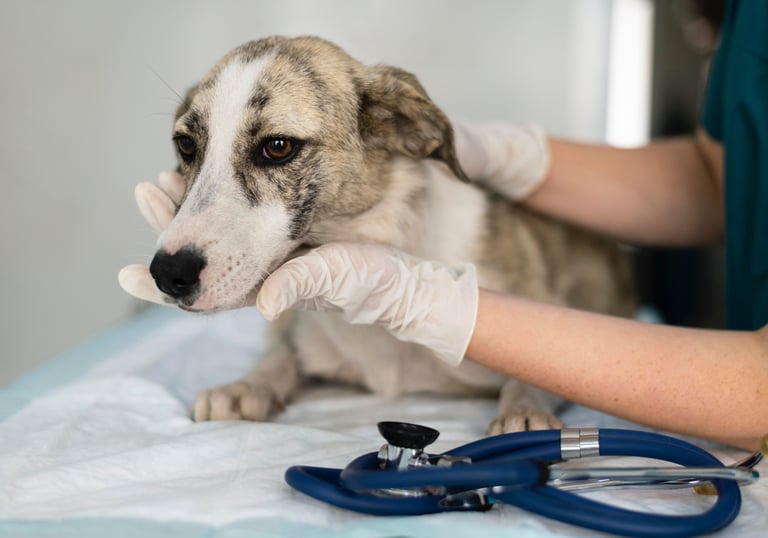
In dogs with protruding eyes (e.g. Pekingese, Bulldog, etc.), special care is required when restraining them (during treatments or grooming). The skin on their forehead and neck must not be pulled backward, as this can cause the eyes to protrude and may lead to blindness. The skin on the forehead should always be pushed forward.
For medium and large-sized dogs, it is advisable to attend a dog training school.
Brushing:
Long-haired animals should be brushed with a regular brush every 1–2 days, while short-haired animals should be groomed once a week using a rubber brush. Medium-length or wire-haired dogs can be groomed with a special comb called a “Furminator.”
Bathing:
Dogs should generally be bathed once every 2–3 months. White-coated dogs and clipped breeds may require bathing every 1–2 months using a special hypoallergenic shampoo.
Nail trimming:
Should be performed by a veterinarian or a professional groomer, as needed.
Ear cleaning:
Every 1–2 weeks, using a slightly damp cotton swab (or one soaked in a special ear-cleaning solution). The use of oil is not recommended.
Tooth brushing:
Primarily, the upper teeth should be wiped every 1–2 days with a damp cloth or a piece of gauze. For more advanced care, using dog toothpaste and a toothbrush is recommended. Please try brushing your dog’s teeth at home-even if it is not perfect, your pet will get used to having its mouth handled, which makes it easier for the veterinarian to examine the oral cavity without anesthesia. About 99% of dogs develop tartar by the age of 3–4, which can lead to gum inflammation, bad breath, loosening of the teeth, and eventually tooth loss. It is recommended to have your pet’s teeth checked at least once a year and to have tartar removed if necessary. Various dental chews, artificial bones, and chew sticks are recommended, but they do not replace brushing or professional tartar removal.
Clipping:
For long-haired animals, the hair should be trimmed as needed around the inner corners of the eyes, around the anus, between the toes, and between the paw pads. If you are unable to do this at home, it is best to leave it to a professional. Groomers can perform clipping by appointment.
Flea control:
Choose only the highest-quality products. Use them all year round, and purchase them from veterinarians or veterinary pharmacies.
Ticks:
Continuous protection is necessary all year round, as ticks can transmit life-threatening diseases. They are present in all green areas (even in the yards of houses with gardens). If, a few days after a tick bite (or after visiting parks, fields, etc.), your dog becomes lethargic, hides, refuses to eat, develops a fever (rectal temperature above 39°C), or even starts passing bloody urine, you must consult a veterinarian immediately! Every lost hour can cost your pet’s life.
Tick removal:
Remove the tick as soon as possible - ticks removed within 48 (up to 72) hours usually do not transmit infection. If you remove the tick by hand, it is difficult to avoid squeezing its body. When the tick is compressed, pathogens inside it can be forced into your pet - similar to pressing the plunger of a syringe.
Therefore, it is recommended to use a tick removal tool, special tweezers, or even a simple thread. The proper removal technique is demonstrated in the video below.
If the tick’s mouthparts (not the “head,” as commonly said) break off, there is no need to worry. They do not contain a significant amount of infectious material, and should be left alone - they will be naturally expelled after a few days, similar to a small inflamed pimple.
Protection against mosquitoes:
Mosquitoes can transmit the larvae of subcutaneous worms and the potentially fatal heartworms into animals during blood feeding. During mosquito season, the disease can be prevented with mosquito repellents, as well as with monthly tablets or spot-on treatments applied to the neck. Screening tests from blood are recommended three times every six months, and then once a year thereafter.
Foxtails:
In spring (late April–May), a type of grass (commonly called foxtail) appears, with seed heads resembling wheat spikes. These often get stuck in people’s socks and are difficult to remove. In the same way, they can burrow into your pet’s skin - most commonly between the toes or into the ears (more rarely into the eyes, nose, or even the genital area).
Prevention:
Keep long-haired dogs trimmed, especially the hair between the toes
After every walk (from May until the end of summer), check between the dog’s toes
Examine the entire body thoroughly
If your dog persistently licks one spot on its paw, or there is redness and swelling between the toes, consult a veterinarian.
If during or after a walk your dog suddenly starts shaking its head noticeably or cries out, a grass awn may have entered the ear - seek veterinary care immediately. (After 1-2 days, the dog may seem to get used to it and stop showing symptoms, but a retained awn can cause severe ear infection.)
Vaccination:
Protection against infectious diseases (parvovirus, distemper, hepatitis, etc.):
Puppy vaccination should be carried out every 2 weeks, ensuring that the puppy also receives a combination vaccine after reaching 3 months of age. Rabies vaccination should be given by 4 months of age, followed by a booster before 10 months of age, and then a repeat combination vaccine at 1 year of age. Rabies vaccination is mandatory every year, and it is also recommended to vaccinate annually against other infectious diseases. Dogs that frequently interact with other dogs should also be vaccinated against kennel cough. Dogs walked in tick-infested areas should be vaccinated against Lyme disease.
Deworming:
In puppies, every 2 weeks, then once every 3-6 months thereafter.
Microchip:
It is implanted under the skin on the left side of the neck. If the dog gets lost, anyone who finds it can have the chip scanned at any shelter or veterinary clinic, and the owner can be identified through the online database (www.petvetdata.hu) using the chip number.
Microchipping can be performed at any age, but it is mandatory from 4 months of age.
In addition, identification can be helped by writing your phone number or address on the inside of the dog’s collar, so you can be reached if your pet runs away. ID tags that can be attached to the collar are also commercially available or can be custom-made, and these can display essential contact details as well.
Passport:
Required for travel abroad; a microchip and a valid rabies vaccination are prerequisites. The passport can be issued at any time after the rabies vaccination. Please check the travel requirements on the official website of the destination country in advance.
Neutering:
Recommended for both male and female animals from 6–10 months of age. Benefits: longer expected lifespan; no heat cycles; no possibility of reproduction; no bleeding during heat; prevention and reduction of sexual behavior-related problems (roaming, aggression, hyperactivity); elimination of persistent preputial discharge in male dogs; and prevention of a number of diseases, including uterine infections, mammary tumors, prostate inflammation, testicular tumors, perineal hernias, and many perianal tumors.
Important information
A dog’s body temperature measured rectally is 38.5–39.0°C. Fever is considered above 39.2°C. Teething begins at around 4 months of age. Female dogs come into heat approximately every six months, although it may occur three times a year or only once a year.
Feeding dogs
Feeding advice
It is advisable to avoid:
raw eggs and raw fish – raw meats (risk of Aujeszky’s disease, salmonellosis, parasites living in muscle tissue, etc.)
Avoid:
onion, garlic (hemolytic anemia)
chocolate (theobromine poisoning)
grapes, raisins, currants (can cause kidney damage in large amounts)
cherries, sour cherries, apricots, plums (their pits contain cyanide and may cause intestinal blockage)
too many bones (constipating effect; in small animals, poorly chewed bones may get stuck in the esophagus)
feeding exclusively meat
fatty food (pancreatitis)
xylitol (found in some jams, chewing gum; toxic to the liver)
Feeding with commercial pet food:
Dry food has the advantage of being more concentrated, so a smaller amount is sufficient to meet the dog’s daily energy needs, and it also has a dental-cleaning effect. Generally, more expensive foods are made from higher-quality ingredients, and manufacturers invest more in their development. With premium-quality dry food, additional vitamin and mineral supplementation is usually not necessary. It is important not to exceed the recommended daily amount indicated on the packaging, as this can easily lead to obesity. For choosing the most suitable food based on your dog’s age and physiological condition, consult your veterinarian.
BARF (Bones and Raw Food diet):
This method involves feeding raw, natural foods. According to BARF, dogs should receive about 2% of their adult body weight daily, divided into two meals. The ratio is 40% meaty bones, 30% vegetables and fruits, and 30% raw meat. Opinions on its use are divided.
Prey model:
In this approach, dogs are not given vegetables or fruits. They are fed only raw meat, with the following ratio: 80% meat, 10% meaty bones, and 10% organ meat. As supplements, only salmon oil and green-lipped mussel extract are recommended. Opinions on its use are also divided.
CONTACT:
Böszi-Vet© 2025 All rights reserved.
COMPANY INFO:
Zsó-Vet Kft.
Tax number: 14291621-2-13
Registration number: 13 09 119692